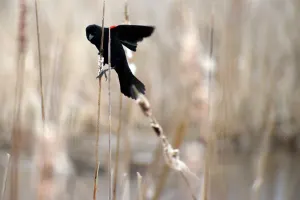
Common Grackle
About the Common Grackle
The Common Grackle is a blackbird upgraded to iridescent: in good light the "black" resolves into a bronze body and a head of deep blue-purple, set off by a staring yellow eye and a long, keel-shaped tail. They stride across lawns with a confident, almost proprietary walk and creak out a song like a rusty gate — a sound grackles alone seem to find beautiful.
Grackles arrive in Michigan in March in noisy flocks, nest in conifers around neighborhoods and farms, and mass into enormous mixed blackbird flocks by late summer. Their adaptability is their superpower — and occasionally their public-relations problem.
Diet
A true omnivore: seeds, grain, and acorns (which they can score open with a hard keel in the bill), plus insects, small fish, frogs — even other birds' eggs and nestlings on occasion. At feeders they favor cracked corn and will dominate if allowed.
Questions birders ask
How is a grackle different from a crow?
Grackles are much smaller and longer-tailed, with a pale yellow eye and iridescent bronze-purple sheen. A crow is half again bigger, all matte black, dark-eyed, and short-tailed by comparison.
How do I keep grackles from emptying my feeders?
Switch to safflower seed (they dislike it), use weight-sensitive or cage feeders that exclude big birds, and skip cracked corn and bread. They usually move on once easy calories dry up.
Why do grackles let ants crawl on them?
It's called anting — the bird crouches and lets ants swarm through its feathers, or wipes them on. The formic acid may help control feather parasites.
What months can I see Common Grackles in Michigan?
March through November, with the best chances from April through October. They spend the winter well to the south of Michigan.
What do young grackles look like?
Juveniles are sooty brown with a dark eye rather than the adult's staring pale yellow one, and lack the iridescent blue-black gloss. The eye color is the quickest way to age one.
What do you call a group of grackles?
A plague, in the traditional listing. In practice they form enormous mixed blackbird flocks in fall, roosting together with starlings, cowbirds, and Red-winged Blackbirds in numbers that can reach the hundreds of thousands.
Easily confused with
Other birds you might be looking at instead.