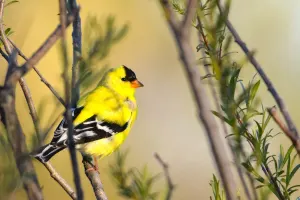
Common Redpoll
About the Common Redpoll
The Common Redpoll is a hardy little finch of the far north that visits Michigan only in winter, and only in some winters. Streaky brown and white, it is marked by a bright poppy-red cap on the forehead and a small black chin, with males adding a rosy wash across the breast. Redpolls travel in restless, twittering flocks that descend on weedy fields, birches, and alders, and pour into feeders offering thistle and fine seed, often mixing with siskins and goldfinches.
Like other winter finches, redpolls are irruptive: when the northern birch and alder seed crop fails, huge numbers move south, and in a good "redpoll winter" flocks can number in the hundreds; in other years they are almost absent. Astonishingly cold-hardy, they can survive temperatures far below zero by roosting in snow tunnels and storing seeds in a throat pouch to digest overnight. Their appearance is one of the highlights of the Michigan winter for feeder-watchers.
Diet
Specializes in the tiny seeds of birch and alder, along with weed and grass seeds, extracting them with a small conical bill and storing seeds in an expandable throat pouch to eat later in the shelter of a roost. At feeders it flocks to nyjer (thistle) and fine sunflower seed.
Questions birders ask
Why do redpolls only show up some winters?
They are irruptive. When the northern birch and alder seed crop fails, large flocks move south into Michigan; when the crop is good, they stay north. The result is boom-and-bust winters, abundant one year and nearly absent the next.
How do redpolls survive extreme cold?
They are among the most cold-hardy songbirds, able to endure temperatures far below zero. They roost in insulating snow tunnels and store seeds in a throat pouch, allowing them to keep digesting food through long, frigid nights.
What should I offer to attract them?
Nyjer (thistle) seed and fine sunflower chips in tube or mesh feeders are the top draws. Redpolls often arrive in large, active flocks and mix with Pine Siskins and American Goldfinches.
What do you call a flock of redpolls?
Just a flock, though the movements themselves have a name — an irruption, the periodic southward push that happens when the northern birch seed crop fails. Some winters bring hundreds, others none at all.
Easily confused with
Other birds you might be looking at instead.