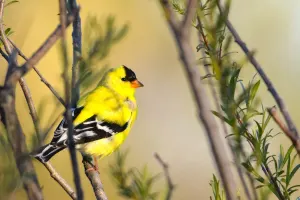
Evening Grosbeak
About the Evening Grosbeak
The Evening Grosbeak is a big, boldly colored finch that seems to arrive at a feeder like a small flock of tropical parrots. The male is striking — a body of golden yellow shading to a dark head, bright yellow "eyebrows," black wings with huge white patches, and an enormous, pale greenish-white bill powerful enough to crack cherry pits. Females are grayer and more subdued but share the massive bill and white-marked wings. Flocks are noisy and gregarious, announcing themselves with ringing, burry call notes.
Once a familiar winter feeder bird across the region, the Evening Grosbeak has declined dramatically in recent decades and is now assessed as Vulnerable, making each visiting flock more of an event than it used to be. It breeds in the coniferous and mixed forests of northern Michigan and appears farther south mainly in winter, in numbers that swing widely from year to year. When a flock does descend on sunflower feeders, its size, color, and appetite make it unforgettable.
Diet
Feeds heavily on the seeds and buds of trees, cracking large, hard seeds with its powerful bill, and takes berries and insects seasonally, including spruce budworm during outbreaks. At feeders it is devoted to black-oil sunflower seed, which large flocks can consume rapidly.
Questions birders ask
Why are Evening Grosbeaks less common than they used to be?
The species has undergone a steep, long-term decline and is now assessed as Vulnerable. The causes are not fully understood but likely include changes in forest and food conditions; once-regular winter flocks are now far less predictable.
How do I identify one?
Look for a stocky finch with a very large pale bill. Males are golden-yellow and black with bold white wing patches and yellow eyebrows; females are grayer with the same massive bill and white wing markings.
What attracts them to feeders?
Black-oil sunflower seed is the main draw, offered on sturdy platform or hopper feeders that can hold a flock. Their powerful bills easily crack seeds, and a group can empty a feeder quickly.
What do young Evening Grosbeaks look like?
Juveniles resemble the gray-and-gold female rather than the black-browed male, with a duller, greenish bill. Bills turn pale green in spring and bone-white by fall in birds of any age, so bill color tells you the season rather than the age.
Easily confused with
Other birds you might be looking at instead.