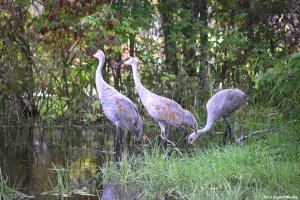
Great Blue Heron
About the Great Blue Heron
The Great Blue Heron is Michigan's sentinel of the shoreline — four feet of blue-gray patience standing motionless in the shallows, then uncoiling a spring-loaded neck to spear a fish faster than the eye can track. In flight the neck folds into an S, the great wings beat slow, and the croaking "frahnk" announces one of our most prehistoric-looking birds.
Herons nest colonially in rookeries — dozens to hundreds of bulky stick nests crowning dead trees in flooded timber, often reused for decades. Most Michigan herons head south when the water hardens, but a few winter wherever current or springs keep a fishing hole open.
Diet
Fish above all, taken with a lightning strike of the dagger bill, plus frogs, crayfish, snakes — and in upland fields, a surprising number of mice and voles. They hunt by stillness, day or night.
Questions birders ask
Is a Great Blue Heron the same as a crane?
No — herons fly with the neck folded back and hunt alone by stalking; cranes fly neck-out, feed in fields, and travel in bugling flocks. The two are commonly confused in Michigan.
How do I keep herons out of my koi pond?
Depth and cover work best: give fish a 2-foot-plus deep zone and hiding structure. Netting is the only near-certain fix. Herons are federally protected, so exclusion is the legal route.
What is a heron rookery?
A colony of stick nests built high in dead trees, usually over water, where dozens of pairs raise young side by side. Colonies are sensitive to disturbance — enjoy them from a respectful distance.
When do Great Blue Herons arrive in and leave Michigan?
First arrivals show up in March, numbers peak from April through October, and the last birds clear out during November. Outside that window Michigan has none.
What do young Great Blue Herons look like?
Juveniles have a dark cap with no white crown or black head plumes, a duller grayish bill, and messier neck streaking. They take about three years to reach full adult plumage, and the long back plumes appear only on breeding adults.
What is a group of nesting herons called?
A rookery, or more precisely a heronry. Great Blue Herons build bulky stick nests high in dead timber over water, dozens in a single stand, and return to the same colony year after year. Away from the colony they feed alone and defend feeding territories.
Easily confused with
Other birds you might be looking at instead.