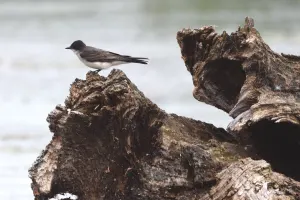
Great Crested Flycatcher
About the Great Crested Flycatcher
The Great Crested Flycatcher is a bird you usually hear before you see — a loud, rising "wheep!" ringing down from the leafy canopy of a summer woodland. When it does show, it is a handsome flycatcher with a gray throat, olive back, lemon-yellow belly, and cinnamon-rufous flashes in the wings and tail. It hunts high in the trees, sallying out to snatch insects, quite unlike the low-perching phoebes and pewees.
Alone among Michigan's flycatchers, this species nests in cavities — old woodpecker holes, natural hollows, and nest boxes — and it has a famous quirk of weaving shed snakeskin (or, these days, crinkly plastic) into the nest lining. It breeds in deciduous and mixed woods across the state from mid-May through August, then heads to the tropics, where it rounds out its insect diet with a heavy dose of fruit.
Diet
Hunts insects high in the canopy, catching butterflies, moths, beetles, katydids, and other large insects in flight or gleaning them from foliage. It also eats considerable fruit and small berries, especially in late summer and on its tropical wintering grounds.
Questions birders ask
What is the loud "wheep" call coming from the treetops?
That ringing, upward-slurred "wheep!" is the Great Crested Flycatcher, one of the most recognizable summer sounds of Michigan's deciduous woods. The bird is often high in the canopy and easier to hear than to spot.
Is it true they use snakeskin in the nest?
Yes. Great Crested Flycatchers frequently weave shed snakeskin into their cavity nests, and will substitute crinkly materials like clear plastic wrappers when snakeskin is not available.
Will it use a nest box?
It can. As Michigan's only cavity-nesting flycatcher, it accepts roomy nest boxes with an appropriately sized entrance, as well as old woodpecker holes and natural tree hollows.
Easily confused with
Other birds you might be looking at instead.