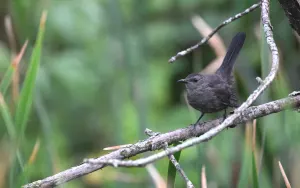
Northern Mockingbird
About the Northern Mockingbird
The Northern Mockingbird is the great mimic of the songbird world, its scientific name Mimus polyglottos meaning "many-tongued mimic." A single bird may work through dozens of imitations — other birds, car alarms, squeaky gates — repeating each phrase several times before switching, and unmated males will sing tirelessly through the day and even into the night. Trim gray with flashing white wing patches and white-edged tail, it is as distinctive in flight as it is in voice.
Mockingbirds are more a southern bird that reaches the northern edge of its range in Michigan, most reliable in the southern Lower Peninsula, where a scattering are year-round residents in towns, suburbs, and shrubby edges. They are famously bold, aggressively defending nests and favorite fruiting shrubs against cats, hawks, and people alike. A winter mockingbird will often stake out a berry-laden bush and drive off all comers.
Diet
Eats insects — beetles, ants, grasshoppers, and spiders — through the warmer months, often caught on open lawns, and shifts to fruit and berries in fall and winter. It fiercely defends fruiting shrubs such as holly and multiflora rose as a winter food supply.
Questions birders ask
Why is a bird singing in the middle of the night?
Unmated male Northern Mockingbirds often sing through the night, especially under bright moonlight or streetlights during breeding season. The nocturnal song is a bid to attract a mate.
Is it common in Michigan?
It is at the northern edge of its range here, most reliable in the southern Lower Peninsula. Some are year-round residents in towns and suburbs, but it is far scarcer in the north of the state.
How do I identify it in flight?
Watch for the big white patches that flash on the gray wings and the white outer tail feathers. On the ground it may raise its wings in jerky steps, thought to startle insects.
Easily confused with
Other birds you might be looking at instead.