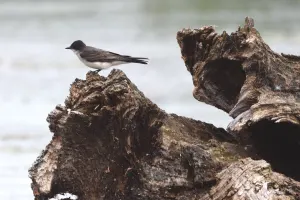
Olive-sided Flycatcher
About the Olive-sided Flycatcher
The Olive-sided Flycatcher is a big, burly, large-headed flycatcher that likes to perch at the very tip of a tall dead snag, surveying the open air and sallying out on long forays to snap up flying insects before returning to the same lookout. Dark olive-gray on the sides forms a "vest" that frames a white central stripe down the breast, giving the odd impression of a bird wearing an unbuttoned waistcoat. Its emphatic, whistled song is famously rendered "quick, THREE BEERS!", with the middle note highest, and it carries far across the northern woods.
Olive-sided Flycatchers breed in open boreal and coniferous forest, especially around bogs, burns, and edges with plenty of tall snags for hunting perches, across northern Michigan and the Upper Peninsula. Most of the state sees them only as migrants. They are long-distance travelers, wintering in South America, and their preference for perching high on dead snags — combined with the distinctive song and vested look — makes them one of the more recognizable flycatchers despite the drab family they belong to.
Diet
An aerial insectivore that hunts from high, exposed perches on dead snags, sallying out on long flights to catch flying insects — especially bees, wasps, flying ants, and beetles — before returning to the same lookout. It favors open settings that give it clear airspace for these hunting forays.
Questions birders ask
What song sounds like "quick, three beers"?
That whistled "quick, THREE BEERS!" with the middle note highest is the Olive-sided Flycatcher. It is one of the most distinctive and easily remembered bird songs of the northern forest.
How do I identify one?
Look for a large, big-headed flycatcher perched at the very top of a tall dead snag, with dark "vested" sides framing a pale central breast stripe. Its habit of hunting from high, exposed perches is characteristic.
Where does it breed in Michigan?
In open boreal and coniferous forest around bogs, burns, and edges with tall dead snags, in the northern Lower Peninsula and Upper Peninsula. Elsewhere in the state it occurs only as a migrant.
Easily confused with
Other birds you might be looking at instead.