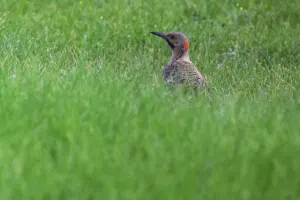
Pileated Woodpecker
About the Pileated Woodpecker
The Pileated Woodpecker is the crow-sized giant of Michigan's forests — jet black with bold white neck stripes and a flaming red crest, the closest living thing to the cartoon Woody Woodpecker. Its wild, ringing "kuk-kuk-kuk" laugh and slow, powerful drumming carry a quarter mile through mature timber.
Pileateds need big trees and standing dead wood, and their fortunes have risen as Michigan's forests have regrown; they're now found statewide, occasionally even in older wooded suburbs. The unmistakable calling card is their feeding excavation: deep, rectangular holes chopped into carpenter-ant-infested trunks, sometimes big enough to fit your fist.
Diet
Carpenter ants are the staple — a single excavation can yield hundreds — plus wood-boring beetle larvae, and wild fruit and nuts in season. They occasionally visit suet feeders near woodlots, an unforgettable backyard event.
Questions birders ask
What makes those big rectangular holes in trees?
That's Pileated work — no other Michigan bird chisels deep, squared-off cavities like that. They're after carpenter ant galleries in the heartwood, and the holes often reveal an infestation the tree already had.
How big is a Pileated Woodpecker?
About 16–17 inches long with a wingspan approaching 30 inches — crow-sized. Seeing one swoop through the woods flashing white underwings is startling even for experienced birders.
Where can I find one in Michigan?
Mature forest with big dead trees, statewide — they're commonest in extensive northern forests but increasingly seen in southern Michigan's older woodlots and river corridors. Listen for the loud, laughing call and follow the drumming.
Do Pileated Woodpeckers stay in Michigan all winter?
Yes — Pileated Woodpeckers are present in Michigan in every month of the year. Numbers stay fairly steady from month to month. Birds are easier to detect in the breeding season, when they are singing and displaying, so a quiet winter month can feel emptier than the population actually is.
What do young Pileated Woodpeckers look like?
Fledglings are as large as adults but with a shorter, floppier crest, duller plumage, and a dark eye rather than the adult's pale yellow one. They follow the parents around noisily for weeks after leaving the nest cavity.
Easily confused with
Other birds you might be looking at instead.