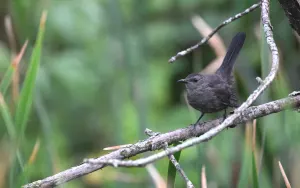
Brown Thrasher
About the Brown Thrasher
The Brown Thrasher is a large, rangy songbird of thickets and brushy edges, rich foxy-brown above and boldly streaked below, with a long tail, a curved bill, and a piercing yellow eye. It spends much of its time on the ground, sweeping its heavy bill side to side through leaf litter to turn up insects — the behavior that gives the family its name. Shy and skulking, it slips through dense cover and is often heard before it is seen.
And heard it is: the Brown Thrasher has one of the largest song repertoires of any North American bird, with over a thousand documented phrase types, each typically sung twice before it moves on to the next. That doubled delivery is the quickest way to tell its song from the catbird's single notes and the mockingbird's triple repeats. Michigan hosts breeding thrashers in shrubby habitat statewide from April through fall.
Diet
Forages mostly on the ground, using its long bill to sweep aside leaf litter for beetles, grubs, caterpillars, and other insects. It also eats fruit, berries, acorns, and seeds, and will occasionally visit ground feeders and platform feeders for seed and cracked corn.
Questions birders ask
How do I tell its song from a mockingbird or catbird?
Count the repeats. The Brown Thrasher typically sings each phrase twice, the Northern Mockingbird repeats phrases three or more times, and the Gray Catbird usually sings each note only once.
Is it related to the American Robin?
No — despite the brown color and streaked breast, it is a thrasher, in the same family as catbirds and mockingbirds, not a thrush. The curved bill, long tail, and yellow eye set it apart.
Where should I look for one?
Low in dense shrubs, hedgerows, and brushy field edges, or on the ground beneath them sweeping through leaf litter. It sings from a high, exposed perch but otherwise stays hidden.
Easily confused with
Other birds you might be looking at instead.