Rusty Blackbird
About the Rusty Blackbird
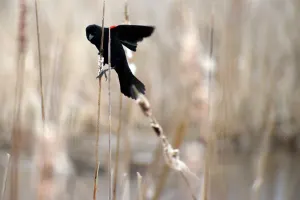
The Rusty Blackbird is a quiet, wetland-loving blackbird that has become the focus of serious conservation concern. In fall its dark plumage is heavily edged with warm rusty-brown (the source of the name), while spring males are a plain glossy black; in all plumages a pale yellow eye and a slim bill help separate it from the similar-looking Common Grackle and Brown-headed Cowbird. Unlike those birds of open country, the Rusty Blackbird haunts wet woods — wooded swamps, flooded forest, and bog edges — where it walks through shallow water flipping leaves for insects.
Once abundant, the Rusty Blackbird has suffered one of the steepest declines of any North American songbird, with populations estimated to have fallen by 85 to 98 percent, and it is now assessed as Vulnerable. The causes are not fully understood but likely include the loss and degradation of the wooded wetlands it depends on in both breeding and wintering areas. In Michigan it passes through as a migrant in spring and fall, favoring swampy woods, with a few lingering into winter — a subtle bird whose plight has made it a conservation priority.
Diet
Feeds on aquatic and terrestrial insects and other invertebrates, foraging by walking through shallow water and wet leaf litter and flipping over leaves, and takes seeds and berries especially outside the breeding season. Its close tie to wooded wetlands for feeding is central to both its ecology and its decline.
Questions birders ask
Why is the Rusty Blackbird a conservation concern?
It has undergone one of the steepest declines of any North American songbird — an estimated 85 to 98 percent drop — and is now assessed as Vulnerable. Loss of the wooded wetlands it depends on is thought to be a major factor.
How do I tell it from a grackle or cowbird?
The Rusty Blackbird has a pale yellow eye and a slim bill, and in fall its plumage is edged with rusty-brown. It favors wet woods, unlike the open-country Common Grackle (longer-tailed, glossier) and Brown-headed Cowbird (smaller, dark-eyed, with a stubby bill).
Where should I look for one?
In wooded swamps, flooded forest, and bog edges during migration, where it walks through shallow water and wet leaf litter. It passes through Michigan in spring and fall, with a few lingering into winter in the south.
Are the rusty feathers a sign of a young bird?
No, they are the fresh fall plumage of any age. Both adults and immatures show rusty feather edges from autumn through early spring, and the edges wear off to leave breeding birds plain dull black.
What is a group of blackbirds called?
A cloud, or a cluster. Rusty Blackbirds move in loose flocks through flooded woods and often mix with grackles and Red-winged Blackbirds, so scanning big blackbird flocks in spring is how most are found.
Easily confused with
Other birds you might be looking at instead.