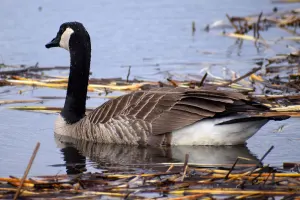
Snow Goose
About the Snow Goose
The Snow Goose is a mid-sized goose of the Arctic that passes through Michigan in migrating flocks, sometimes numbering in the hundreds or thousands, filling the sky with white and black. Most are the white morph — snowy white with black wingtips and a pink bill marked by a dark "grinning patch" — but a dark "blue morph," slate-gray-bodied with a white head, regularly occurs mixed in, and the two were once thought to be separate species. Flocks are noisy, giving high, barking calls as they wheel down into fields to feed.
Snow Geese breed on the high Arctic tundra and winter to the south, passing through Michigan chiefly in spring and fall on flooded fields, marshes, large lakes, and grain fields, where they graze on grasses, waste grain, and roots. Their populations have grown enormously in recent decades — so much that dense feeding flocks now damage fragile tundra breeding grounds. Picking a Snow Goose or its blue morph out from among the resident Canada Geese is a familiar pleasure of the state's migration seasons.
Diet
Grazes on grasses, sedges, waste grain, roots, and aquatic plants, feeding in large flocks on flooded fields, marshes, and grain fields. It grubs energetically for roots and tubers as well as clipping green vegetation, and its dense feeding flocks can strip and damage the plants they exploit.
Questions birders ask
What is the "blue goose"?
It is a dark color morph of the Snow Goose — slate-gray-bodied with a white head — that regularly mixes with the white-morph birds. The two were once considered separate species but are now known to be the same.
How do I tell a Snow Goose from other geese?
The white morph is white with black wingtips and a pink bill bearing a dark "grinning patch," quite unlike the brown Canada Goose. Blue-morph birds are dark-bodied with a white head. Both often travel in large, noisy flocks.
When does it pass through Michigan?
Mainly in spring and fall migration, when flocks stop on flooded fields, marshes, large lakes, and grain fields. It breeds on the Arctic tundra and does not nest in the state.
Why are some Snow Geese gray?
Two reasons: juveniles of the white form are dusky gray-brown through their first winter, and the species also has a permanent dark 'blue morph' with a white head. Goslings hatch yellow or gray depending on morph.
What do you call a group of Snow Geese?
On the ground or water they are a gaggle; in flight the same birds are a skein, or a wedge when in a clean V. Snow Goose skeins can number in the thousands and are usually heard before they are seen.
Easily confused with
Other birds you might be looking at instead.