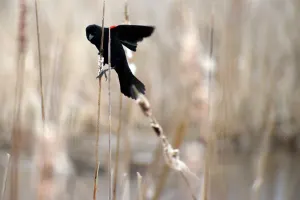
Yellow-headed Blackbird
About the Yellow-headed Blackbird
The male Yellow-headed Blackbird is unforgettable — a robust blackbird with a brilliant, saturated golden-yellow head and breast, a black body, and bold white patches in the wings that flash in flight. The female is smaller and browner with a duller yellow throat and chest. As striking as the male looks, his song is comically awful: a strained, rasping, mechanical grinding that sounds like a rusty gate being forced open, one of the least musical sounds in the marsh, delivered with the bird leaning forward and spreading its wings.
Yellow-headed Blackbirds are birds of large, deep-water cattail and bulrush marshes, where they nest in colonies, often taking the prime central territories over deeper water and displacing the smaller Red-winged Blackbirds to the edges. Primarily a western species, it reaches the eastern edge of its range in Michigan and breeds locally, mostly in the western and southern parts of the state where big marshes with open water occur. Finding a colony of these gaudy, raucous blackbirds is a memorable experience amid the reeds.
Diet
Feeds on insects — especially aquatic insects and their larvae during the breeding season — along with seeds and waste grain, foraging in marshes, fields, and along edges. Insects dominate when feeding young, while seeds and grain become more important at other times, often taken in flocks in agricultural land.
Questions birders ask
Why does such a beautiful bird have such an ugly song?
The male Yellow-headed Blackbird's song is a strained, rasping, mechanical grind, often likened to a rusty gate. Despite the bird's brilliant plumage, the harsh song is one of the least musical sounds in the marsh.
How does it interact with Red-winged Blackbirds?
Yellow-headed Blackbirds are larger and dominant, often claiming the prime central marsh territories over deeper water and displacing Red-winged Blackbirds to the edges. The two frequently nest in the same large marshes.
Where does it occur in Michigan?
Locally, mainly in the western and southern parts of the state, in large cattail and bulrush marshes with deep, open water. It is chiefly a western species reaching the eastern edge of its range here.
Do Yellow-headed Blackbirds form flocks?
Yes — they nest in loose marsh colonies and gather into larger flocks after breeding, often joining other blackbirds. In Michigan the colonies are small and localized to a handful of big marshes.
Easily confused with
Other birds you might be looking at instead.