Most people think of fall migration as a September and October event. For shorebirds, that's already late. The southbound push begins in July and hits full stride in August, which makes right now the single best stretch of the year to watch sandpipers, plovers, and yellowlegs work the mudflats of West Michigan.
Why August?
The birds driving the August surge are long-distance migrants that nest on the Arctic tundra — Semipalmated and Pectoral Sandpipers, Sanderling, Black-bellied Plover — for whom Michigan is purely a refueling stop. Up north, the breeding season is compressed into a few frantic weeks. Once the chicks are on their own, adults leave almost immediately, with many heading south by mid-July. Juveniles follow weeks later, feeding and growing before they make the trip.
That staggered departure is what makes August so rewarding. Early in the month you're mostly seeing worn adults, some still carrying traces of breeding plumage: the brick-red underparts of a Dunlin, the black belly patch on a Black-bellied Plover. By the last week of August, the flocks shift toward crisp, neatly patterned juveniles on their first migration. Two different looks at the same species, four weeks apart.
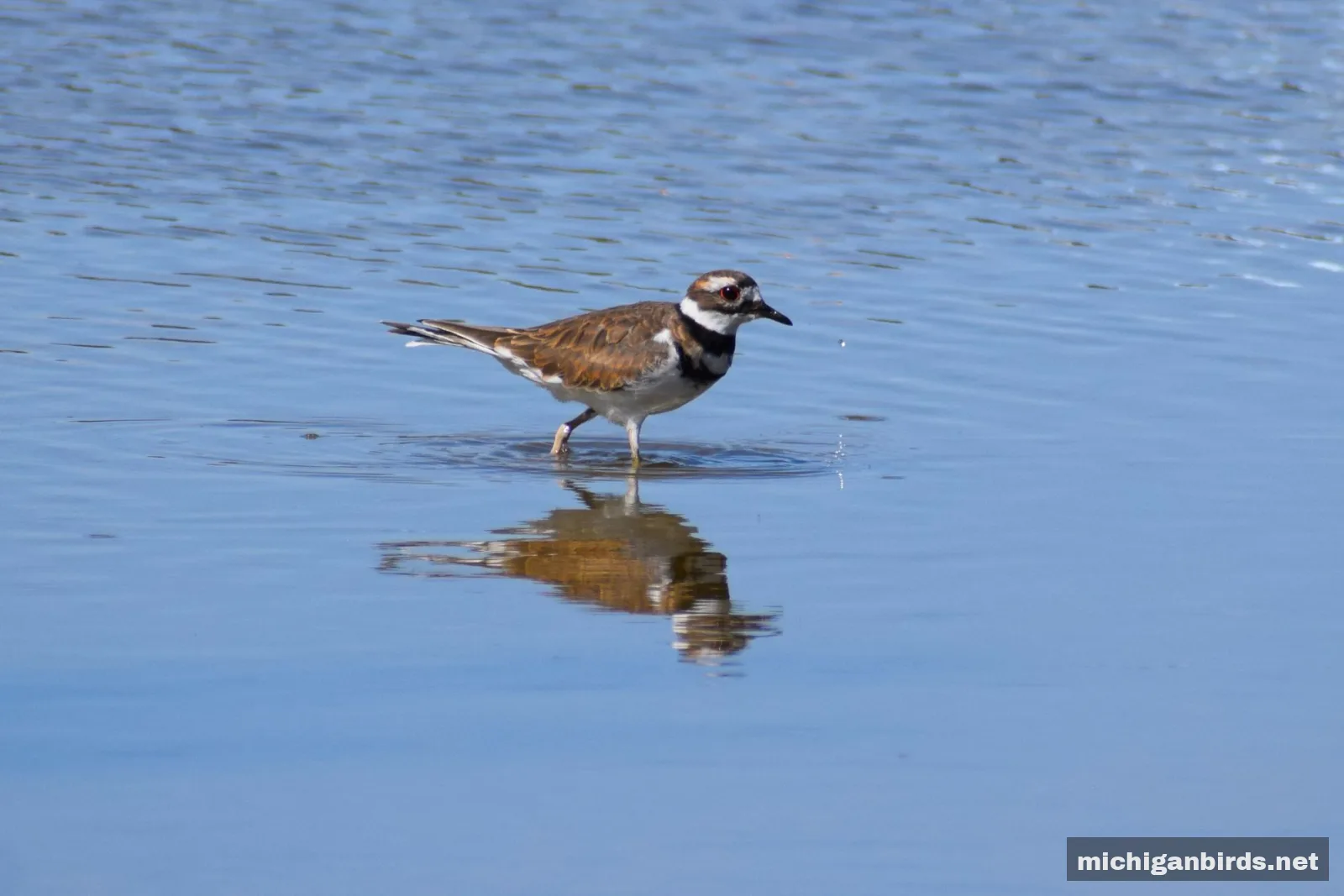
Not every shorebird you'll see fits that pattern, though. Killdeer nest right here in West Michigan, on gravel lots, flat rooftops, lawns, and farm fields, and Spotted Sandpipers breed along our own ponds, rivers, and lakeshores — both are with us all summer. Solitary Sandpiper splits the difference: it nests in the boreal forest of Canada rather than on open tundra, and does something almost no other shorebird does — lays its eggs in abandoned songbird nests up in trees. So an August flock can mix true Arctic travelers, boreal migrants, and local birds that never left.
It also helps that late summer is when water levels drop. Exposed mud is the whole game — shorebirds need shallow, open flats to probe, and August delivers more of that habitat than any other month.
What to Expect
A good West Michigan day in August can turn up Least, Semipalmated, Pectoral, Solitary, and Spotted Sandpipers, both Greater and Lesser Yellowlegs, Semipalmated Plover, Killdeer, and Sanderling. Push into the second half of the month and Baird's Sandpiper and Stilt Sandpiper become realistic. Buff-breasted Sandpiper — a grassland-loving shorebird that prefers dry sod and short turf over mud — is a late-August specialty worth watching for. American Golden-Plover typically arrives toward the end of the window.
Where to Go
Muskegon County Resource Recovery Center (Wastewater System) is the anchor site for the entire region, and one of the best inland shorebird locations in Michigan. The property as a whole is big — large storage lagoons plus thousands of acres of agricultural fields — but the shorebirding happens on a much smaller footprint: the drawdown cells and seasonal flats where receding water exposes mud. When conditions line up there, you can work through a lot of species in a single morning without leaving the car. A visitor pass is required — you must stop at the wastewater system office and obtain one before touring the site, and birders caught on the property without a pass can be ticketed. Passes can be requested through the birdwatching page or by calling the office at 231-724-3440; if you can show membership in a birding organization, you may be issued an annual pass. Bring a scope — the distances are long.
Muskegon State Park (Snug Harbor and the channel) offers a different mix, leaning toward waterfowl and beach shorebirds: Sanderlings running the surf line and Semipalmated Plovers working the wet sand. Check the Purple Martincolony at the Muskegon Lake end of the channel while you're there — early August is your last good chance at them. Martins are among the first songbirds to leave, gathering into staging flocks and clearing out of Michigan by late in the month. A Michigan Recreation Passport is required to park here. Michigan residents buy it annually — $15 when added to your license plate renewal, or at the park for an added convenience fee. Non-residents can choose a daily pass ($12) or an annual ($42). Adjacent Pere Marquette Beach is a City of Muskegon park with no state pass required, though summer parking fees may apply. Early mornings, before beach traffic builds, are essential at both.
Ottawa County's Grand River corridor — Harbor Island, Connor Bayou, Eastmanville Bayou, and the flats around Bass River — can be excellent when water is low. Ottawa County Parks are free to enter, and these quieter spots reward repeat visits rather than a single stop.
Allegan State Game Area's Fennville Farm Unit and the surrounding flooded fields are worth a swing when conditions are right, especially for Pectoral and the occasional Stilt Sandpiper. State game areas don't require a Recreation Passport for general parking, but DNR boating access sites within them do.
Farther north, Pentwater Lake, Silver Lake, and the White Lake channel all pull in migrants, and the Ludington-area beaches are good for Sanderling and plovers. Note that Charles Mears, Silver Lake, and Ludington State Parks all require a Recreation Passport.
A Few Tips
Go early. Heat shimmer off a mudflat by 11 a.m. will ruin your views. Use a scope, scan slowly, and expect to re-scan — a flock will change composition as birds drop in and out. Watch your distance on beaches, where Piping Ploversmay still be present into early August, and stay behind posted fencing.
The window is open now. By late September the flats will be quiet again.